
RG58 vs RG8X Coax: Which Cable Should You Choose?
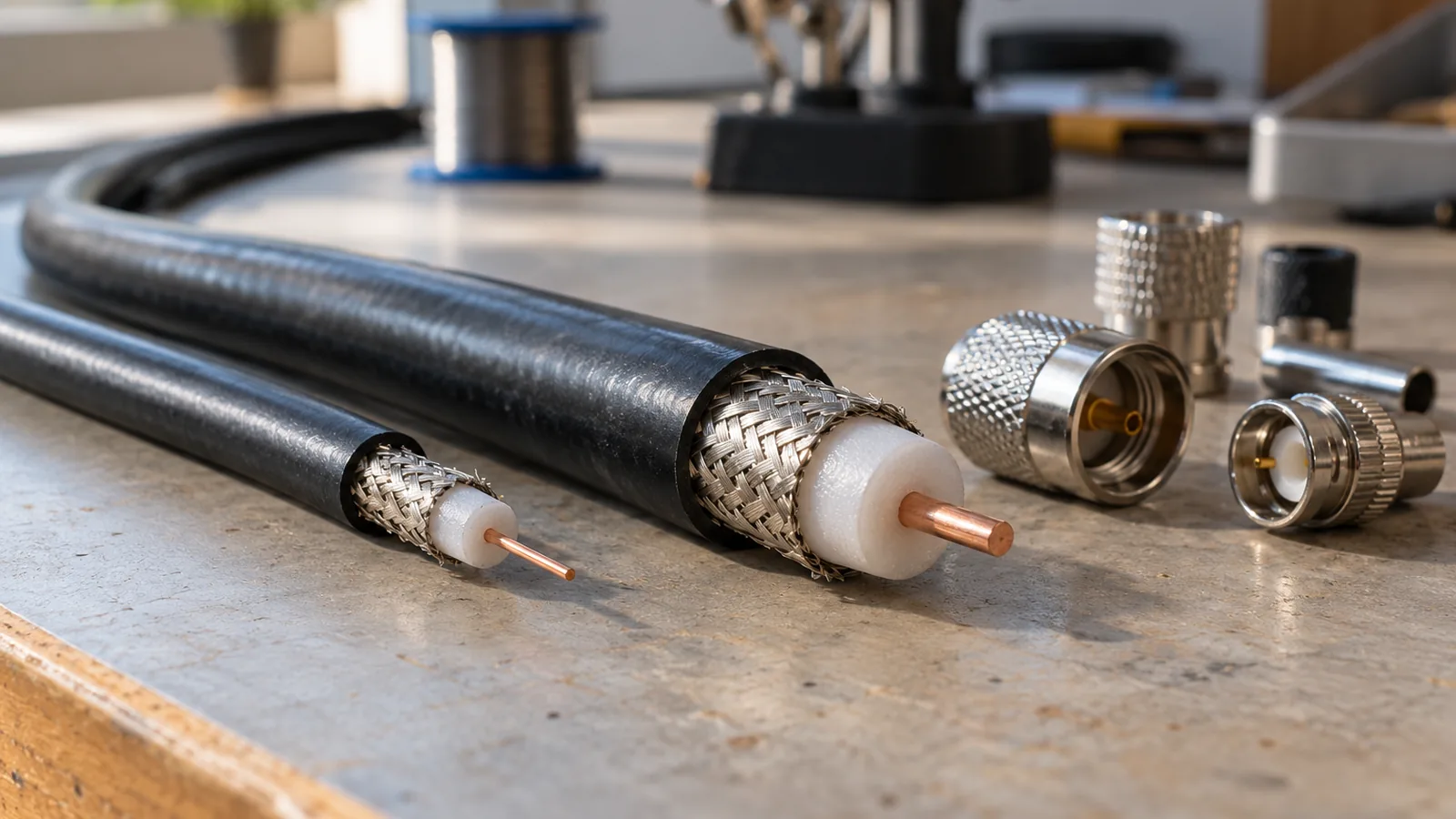
For the cited Belden models, RG-8X has lower attenuation than RG-58 at every listed shared frequency, while RG-58 is thinner: 0.193 in versus 0.242 in. Choose based on your run length, frequency, and routing space, and check the exact cable’s power rating before transmitting.
Quick answer
RG58 vs RG8X coax: which should you choose?
Choose RG-8X if its exact model has lower attenuation at your frequency and its larger diameter fits your route; for the cited Belden models, RG-8X measures 0.242 in and RG-58 measures 0.193 in. Estimate run loss by multiplying the cable’s dB per 100 ft by your run length in feet, then dividing by 100.
- For less cable loss: Compare the exact cable’s attenuation at your operating frequency; Belden 9258 RG-8X has lower listed loss than 8219 RG-58 at each shared frequency.
- For tight routing: Check the cable’s diameter and minimum bend radius; the cited Belden RG-58 is thinner and has a smaller minimum bend radius.
- For transmitting power: Use the exact cable’s power rating at your frequency and conditions, and choose a rating above your transmitted power; the cited RG-58 datasheet has no RF power-rating table.
- Before installation: Confirm the connector matches the cable’s diameter and construction.
How Do RG58 and RG8X Specifications Compare?
Belden’s 9258 RG-8X has lower listed attenuation than its 8219 RG-58 at every shared test frequency, while the RG-58 is thinner. At 100 MHz, loss is 3.1 versus 4.5 dB per 100 ft, respectively.
| Belden cable | Impedance | Outside diameter | 10 MHz | 50 MHz | 100 MHz | 400 MHz | 900 MHz |
|---|---|---|---|---|---|---|---|
| 8219 RG-58 | 54 Ω | 0.193 in (4.90 mm) | 1.3 dB/100 ft | 3.1 dB/100 ft | 4.5 dB/100 ft | 10.0 dB/100 ft | 16.6 dB/100 ft |
| 9258 RG-8X | 50 Ω | 0.242 in (6.15 mm) | 0.9 dB/100 ft | 2.1 dB/100 ft | 3.1 dB/100 ft | 6.6 dB/100 ft | 10.7 dB/100 ft |
The figures are for specific Belden models, not guaranteed values for every cable sold as RG-58 or RG-8X. At 50 MHz, for example, Davis RF lists RG-58/RG-8X loss at 4.1/2.0 dB per 100 ft, while Belden lists 3.1/2.1 dB per 100 ft for its models. Compare the exact cable’s specification at your operating frequency, since attenuation rises with frequency in the listed Belden 9258 data.
To estimate cable loss, multiply the attenuation in dB per 100 ft by your run length in feet, then divide by 100. That gives you an estimate for the cable run, not a power rating.
Belden lists the 9258 RG-8X at 1,000 W at 10 MHz and 250 W at 100 MHz; its rating falls at higher listed frequencies. The cited 8219 RG-58 datasheet provides voltage ratings but no RF power-rating table, so these specifications don’t support a matched power comparison. Check the exact cable’s rating at your operating frequency and conditions, and select a rating above your transmitted power.
What Changes When You Install RG8X?
RG8X takes more routing space than RG58, so check clearances and connector fit before you install it. In the Belden models compared here, RG8X 9258 measures 0.242 in in diameter, while RG58 8219 measures 0.193 in. That difference can matter in tight cable paths or where a connector must pass through an opening.
Bend limits also differ between those specific products: Belden specifies a 2.4 in minimum bend radius for RG8X 9258, compared with 1.9 in for RG58 8219. Plan the RG8X route with enough room to avoid bending it more tightly than its specified limit. These figures don’t establish a flexibility ranking for every cable sold as RG8X or RG58.
Choose connectors by the cable’s actual diameter and construction, rather than relying on the RG58 or RG8X label alone. Assemblies are sold with PL-259/UHF connectors for both types, but the Belden specifications don’t prescribe a connector for the radio end. Check that the connector is specified for the exact cable you’re installing, and confirm it fits your radio or other equipment.
For the rg58 vs rg8x coax installation decision, account for the route as well as the cable’s electrical specifications. Measure narrow openings and tight turns before choosing a cable, then verify the connector’s fit against the exact product details. A cable’s type designation alone doesn’t confirm that a particular connector will fit.
Which Cable Fits Your Run and Radio?
Choose RG-8X when the exact cable’s lower loss at your operating frequency matters more than its larger size; choose RG-58 when the run is short or routing space is tight, provided its specifications meet your needs. The right decision depends on your run and operating conditions, not the cable label alone.
Use the exact cable product’s data, since figures vary with construction and manufacturer.
- For a long run or higher frequency: Favor the cable with lower attenuation at your operating frequency if reducing loss is the priority. Belden’s 9258 RG-8X has lower listed attenuation than its 8219 RG-58 at each shared frequency, but other products can differ.
- For higher transmit power: Check the exact cable’s RF power rating at your operating frequency and conditions, and confirm it exceeds your transmitted power. Belden lists power ratings for its 9258 RG-8X, but its 8219 RG-58 datasheet provides no matched RF power-rating table, so don’t infer a rating from the RG designation.
- For tight routing: Check the specific cable’s outside diameter and minimum bend radius against your installation space. The cited Belden 8219 RG-58 is thinner and has a smaller minimum bend radius than Belden 9258 RG-8X, but that comparison doesn’t establish a rule for every product sold under those designations.
Before ordering, verify connector fit for the cable’s actual diameter and construction. RG-58 and RG-8X labels alone don’t guarantee that a connector will fit.
RG58 vs RG8X at a Glance
RG-8X has lower listed attenuation than RG-58 at every shared frequency, while the cited RG-58 cable is thinner and has a smaller minimum bend radius. The power figures below apply only to Belden 9258 RG-8X; the cited Belden 8219 RG-58 datasheet doesn’t provide an RF power-rating table.
| Measure | Frequency (MHz) | RG-58 8219 | RG-8X 9258 | Units | Source |
|---|---|---|---|---|---|
| Impedance | — | 54 | 50 | Ω | catalog.belden.com belden.com |
| Outside diameter | — | 0.193 | 0.242 | in | catalog.belden.com belden.com |
| Attenuation | 10 | 1.3 | 0.9 | dB/100 ft | catalog.belden.com belden.com |
| Attenuation | 50 | 3.1 | 2.1 | dB/100 ft | catalog.belden.com belden.com |
| Attenuation | 100 | 4.5 | 3.1 | dB/100 ft | catalog.belden.com belden.com |
| Attenuation | 400 | 10.0 | 6.6 | dB/100 ft | catalog.belden.com belden.com |
| Attenuation | 900 | 16.6 | 10.7 | dB/100 ft | catalog.belden.com belden.com |
| Power rating | 10 | — | 1,000 | W | belden.com |
| Power rating | 50 | — | 370 | W | belden.com |
| Power rating | 100 | — | 250 | W | belden.com |
| Power rating | 200 | — | 190 | W | belden.com |
| Power rating | 400 | — | 110 | W | belden.com |
| Power rating | 700 | — | 75 | W | belden.com |
| Power rating | 1,000 | — | 60 | W | belden.com |
Chart of the table above.
The attenuation gap grows at higher listed frequencies, so compare loss at your operating frequency and scale it to your cable run. The impedance figures differ, so check your radio and system requirements before choosing. Use the exact cable’s power rating at your operating frequency; the RG designation alone doesn’t establish a safe power limit.
Frequently Asked Questions
Does replacing RG58 with RG8X affect antenna tuning?
Usually, no: changing coax alone doesn’t change the antenna’s physical tuning, but it can change the loss between the antenna and radio. Check both cables’ impedance and the full system requirements, since the cited Belden RG-58 and RG-8X models are rated at 54 Ω and 50 Ω, respectively.
Is RG8X suitable for outdoor or buried coax runs?
RG8X can suit an outdoor run if the exact cable is rated for that installation; the RG8X label alone doesn’t establish outdoor or direct-burial suitability. Check the cable’s construction and installation instructions before routing it outside or underground, and protect the run as those instructions require.
How do I identify the exact RG58 or RG8X cable specification?
Use the manufacturer and full model number, then check that product’s datasheet for attenuation at your frequency, impedance, diameter, bend radius, and power rating. Those details can vary among cables with the same RG designation, so don’t use the type label as a substitute for the exact specifications.
How long can an RG58 or RG8X coax run be?
There’s no single maximum length; choose a run length based on the loss you can accept at your operating frequency.
Does coax cable loss affect receiving as well as transmitting?
Yes, coax loss affects both received and transmitted signals because the cable attenuates signals passing through it. Estimate loss at your operating frequency and actual run length, since attenuation rises with frequency in the cited Belden RG-8X data.
Conclusion
If your run is long or you’re operating at a higher frequency, choose the exact RG-8X cable with lower listed attenuation, as long as its diameter and bend limits fit your route. If space is tight or the run is short, RG-58 may be the simpler fit, provided its loss and power specifications meet your needs. Before buying, calculate expected loss for your run, check the cable’s rating at your operating frequency, and confirm the connector matches its construction and fits your equipment.
Sources
- catalog.belden.com (catalog.belden.com)
- 50 Ohm Coax Cable – 9258 (belden.com)
- davisrf.com (davisrf.com)
- dxengineering.com (dxengineering.com)
- theantennafarm.com (theantennafarm.com)
