Difference Between AM and FM CB Radio: Which Is Better?
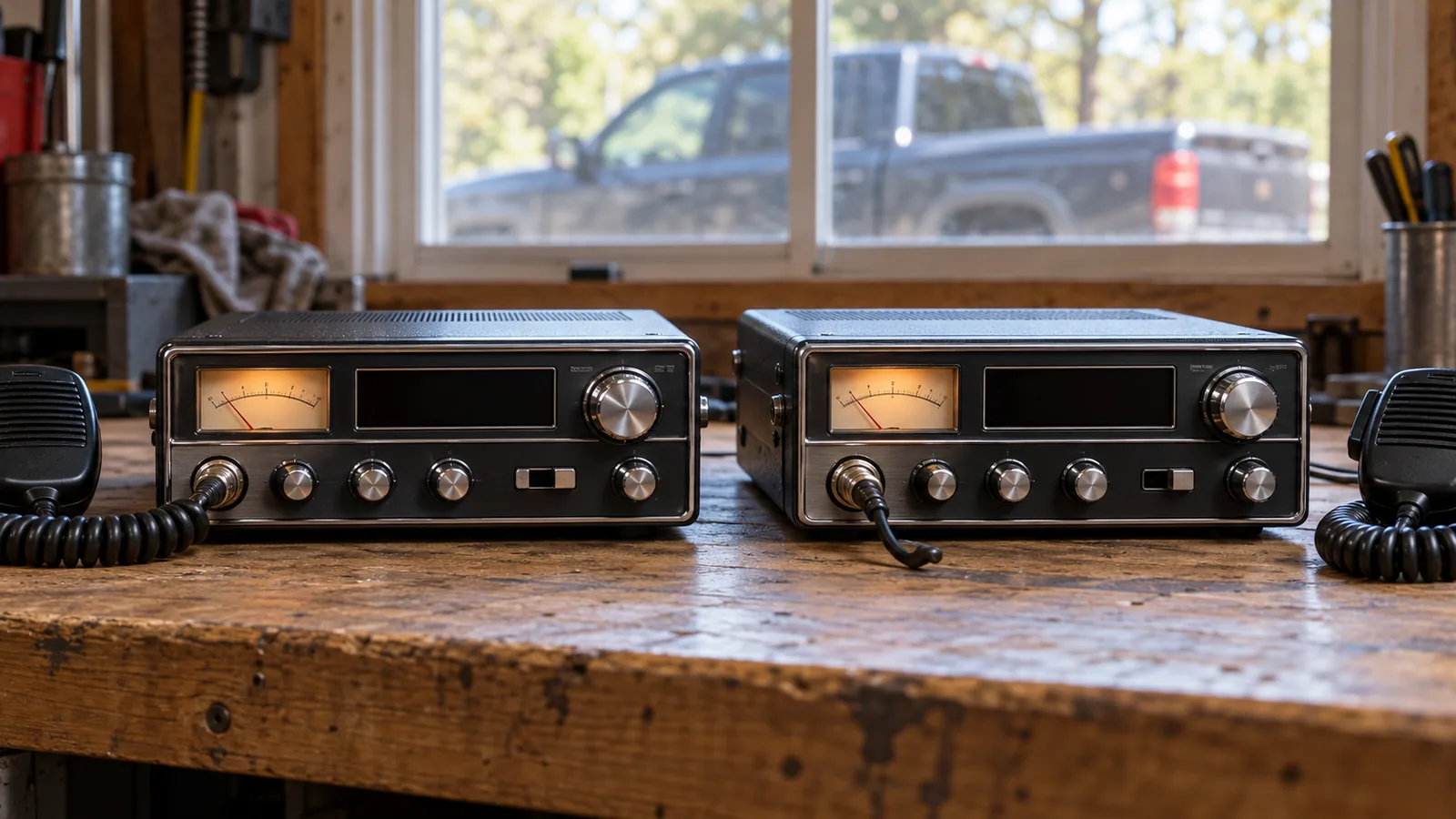
The difference between AM and FM CB radio is how they carry and receive voice, not which channels they use. You must set both radios to the same mode on the same channel, or they won’t communicate properly. FM can sound clearer when the signal is strong enough, while AM is the safer starting point when you don’t know which mode other operators use.
Choose FM when everyone in the conversation has FM and background noise is a concern. Near the edge of reception, FM may become noisy or drop out, while AM can sometimes remain understandable. Check the mode before transmitting, even when channel numbers match.
Key Takeaways
- AM is the safer default when you don’t know other users’ mode, since AM-only radios can’t properly receive FM.
- Both radios must use the same mode to communicate, even on the same channel frequency.
- 40 channels and 4 W apply to both AM and FM CB radio.
- FM can reduce amplitude noise and sound clearer when the signal is strong enough.
- AM may remain understandable near the weak-signal threshold, while FM can become noisy or drop out abruptly.
Quick Verdict: AM or FM?
Choose AM when you’re unsure. AM is the safer choice when you don’t know which mode other CB users have selected, because established CB users may have AM-only radios that can’t properly receive FM. The difference between am and fm cb radio comes down to more than audio: your radio and the other radios must use the same mode to communicate.
FM is optional; AM is mandatory. U.S. CB rules allow voice transmissions in either AM or FM, but every CB radio must support AM. The FCC approved FM as an optional CB mode on September 24, 2021, so FM is available on radios that include it, but it hasn’t replaced AM. That makes AM the practical default when you’re calling people whose equipment or settings you don’t know.
Pick FM when everyone’s set to FM. FM can sound clearer and reduce background noise when the received signal is strong enough. For a conversation where the other radios are confirmed to be on FM, choose FM if quieter audio is useful. If you’re unsure, use AM to improve your odds of being heard by AM-only radios, since they can’t properly receive an FM transmission.
Neither mode works as a universal setting across all CB radios: an AM receiver doesn’t properly demodulate FM, and an FM receiver doesn’t properly demodulate AM, even when both radios are tuned to the same channel frequency. Match the other radio’s mode before you transmit; if you can’t confirm it, start with AM.
AM and FM CB Radio Compared
AM and FM share the same channel plan and power limit, but the radios must use the same mode to communicate.
| Comparison | AM | FM | Source |
|---|---|---|---|
| Channels and frequency range (MHz) | 40 channels; 26.965 on Channel 1 to 27.405 on Channel 40 | 40 channels; 26.965 on Channel 1 to 27.405 on Channel 40 | ecfr.io |
| Maximum mean carrier power (W) | 4 W | 4 W | ecfr.io |
| Mode compatibility | Communicates with AM radios on the same channel | Communicates with FM radios on the same channel | cobra.com |
| Audio and noise behavior | More susceptible to amplitude noise, including vehicle electrical noise | Can reduce amplitude and impulse noise and sound clearer with a strong enough signal | arrl.org cobra.com |
| Weak-signal behavior | Can sometimes remain understandable amid noise | Can become noisy or drop out abruptly near the weak-signal threshold | worldradiohistory.com |
The channel and power rules don’t give either mode a longer channel list or a higher legal voice-power limit. What changes is how each mode handles interference and weak signals, so the cleaner-sounding option may not be the easier one to hear at the edge of coverage.
FM’s capture effect also affects overlapping transmissions: it tends to favor the stronger signal, which can suppress the weaker one. AM may let both signals through, leaving you with mutual interference instead.
Why Matching Modes Matters
If you and the other operator select different modes, you won’t communicate properly, even when you’re on the same channel frequency.
Demodulation is how a receiver turns a radio signal into audio. A mismatch can leave you with unintelligible sound rather than a usable conversation, so check the mode setting as well as the channel.
Existing AM-only radios can’t properly receive FM, so an FM call may go unheard by those users. AM remains the safer choice for reaching established CB users whose radios or settings you can’t confirm.
How Audio and Interference Differ
FM can sound cleaner than AM when the incoming signal is strong enough, because FM rejects much amplitude variation and impulse noise. FM reduces amplitude noise such as brief electrical spikes, while AM is more affected by amplitude noise from sources such as vehicle electrical systems.
That advantage depends on signal strength. Near the weak-signal threshold, FM can become noisy or drop out abruptly, while AM may remain understandable through the noise. Weak-signal results vary with receiver design, interference, antenna, terrain, and signal strength, so mode alone doesn’t determine reception.
FM also handles overlapping transmissions differently: its capture effect tends to favor the stronger signal, which can suppress a weaker one on the same channel.
These differences don’t make FM a guaranteed fix for noise or a way to extend range. Reception can still depend on your antenna, terrain, receiver, and interference.
Which Mode and Radio Should You Choose?
- Choose AM: You need compatibility with existing CB users, or you can’t confirm their radios support FM. AM-only radios can’t properly receive an FM transmission.
- Choose FM: The other radios are set to FM, and you want clearer audio when the signal is strong enough.
- Choose a dual-mode radio: You want the option to switch modes to match the people you’re calling. The Cobra 19 MINI AM/FM, President Harrison FCC and President Bill III are listed as AM/FM models.
| Model | Modes and description | Listed price (USD) | Source |
|---|---|---|---|
| Cobra 19 MINI AM/FM | 40-channel, 4 W dual-mode | $99.95 and $79.95 | cobra.com |
| President Harrison FCC | FCC-approved AM/FM; CTCSS/DCS | — | president-electronics.us |
| President Bill III | FCC-approved ultra-compact AM/FM | — | president-electronics.us |
The Cobra listing displays two prices, so check the current listing before you buy; listed prices can change. The President datasheets describe the models but don’t give retail prices. A dual-mode radio gives you flexibility, but it can’t make a single-mode radio receive the other mode.
Frequently Asked Questions
Do I need a different antenna to use FM on a CB radio?
No, the mode alone doesn’t require a different antenna: AM and FM CB use the same 40 channels and channel frequencies. You do need an FM-capable radio, and the other radio must also be set to FM; matching antennas or channels can’t make different modes communicate.
Can I add FM to an AM-only CB radio?
No, an AM-only CB radio can’t properly receive FM transmissions, even on the same channel. You’ll need a radio that supports FM to communicate in that mode, and AM remains required for CB radios under U.S. rules.
How do I switch between AM and FM on a CB radio?
Use your radio’s mode control or display to select AM or FM, then match the other radio’s setting before you transmit. If you can’t confirm the other users’ mode, choose AM, since AM-only radios can’t properly receive FM.
Do all new CB radios support FM?
No, FM is optional, while AM support is required for CB radios in the United States. Check the radio’s listed modes before buying; a dual-mode model lets you match FM users while keeping AM available for broader compatibility.
Can AM and FM CB radios communicate through a repeater?
No, using a repeater doesn’t make an AM radio properly receive FM or an FM radio properly receive AM. The radios still need to use the same mode, so confirm the other station’s setting and choose AM when you don’t know it.
Conclusion
Before buying a radio, check that it supports the modes you expect to use; a dual-mode model lets you match either group. Next, check your radio’s mode control, set the channel and mode together, and make a brief call to confirm the other operator can hear you.
Sources
- 47 CFR 95.963 | CBRS channel frequencies | eCFR.io (ecfr.io)
- 47 CFR 95.967 | CBRS transmitter power limits | eCFR.io (ecfr.io)
- cobra.com (cobra.com)
- 19 MINI AM/FM (cobra.com)
- president-electronics.us (president-electronics.us)
- worldradiohistory.com (worldradiohistory.com)
- arrl.org (arrl.org)
- docs.fcc.gov (docs.fcc.gov)
- president-electronics.us (president-electronics.us)