Handheld vs Fixed Mount VHF Marine Radio: Which Fits?
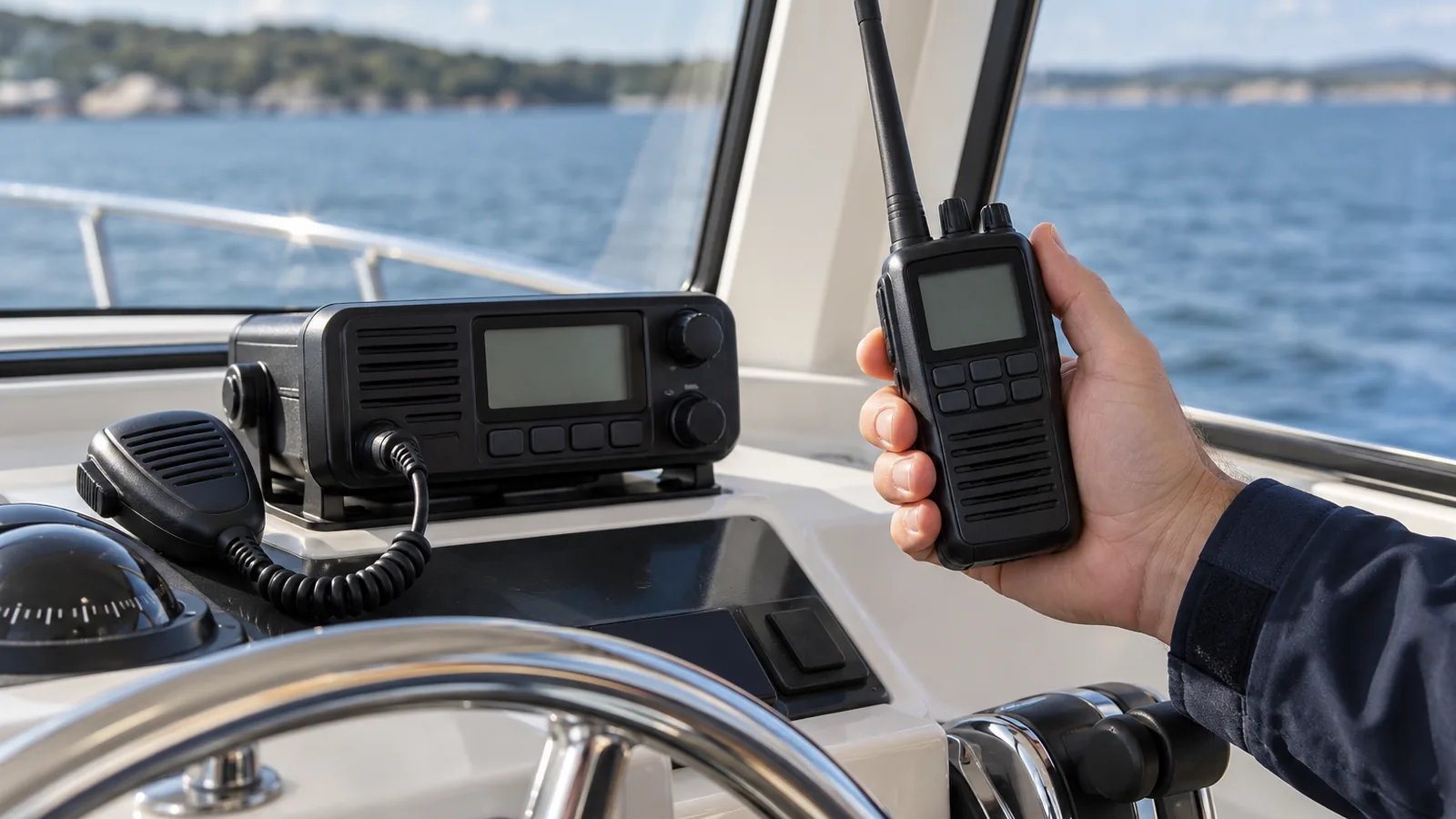
For a handheld vs. fixed-mount VHF marine radio, a fixed-mount set generally makes a better primary radio, with a Garmin model transmitting at up to 25 W. Choose a handheld as your main radio if you can’t install boat power and a separate antenna, or need to carry it around the boat. Higher transmit power doesn’t guarantee more range.
Quick answer
Should you choose a handheld or fixed-mount VHF marine radio?
Choose a fixed-mount VHF as your boat’s primary radio if you can connect it to boat power and a separate marine antenna; add a handheld for portable communication and backup. Use a handheld as your main radio if your boat can’t support that installation or you need to carry the radio around the boat. Transmit power alone doesn’t determine range, because antenna height and placement affect line-of-sight communication.
- Primary radio: Choose fixed-mount when your boat supports the installation.
- Portable or backup radio: Add a handheld for use away from the helm or if the installed set becomes inaccessible.
- No suitable installation: Choose a handheld as your main radio, and check the specific model’s battery runtime.
How do handheld and fixed-mount radios compare?
The main difference is where each radio gets its power and antenna: a handheld carries both with you, while a fixed-mount radio connects to boat power and a separate antenna. Antenna placement affects range, so transmit power alone doesn’t tell you how far a fixed-mount radio will reach.
| Feature | Handheld | Fixed-mount | Source |
|---|---|---|---|
| Installation | Portable unit | Installed aboard | www8.garmin.com standardhorizon.com |
| Power source | Battery | Boat power; Garmin VHF 315 uses 12 V DC | www8.garmin.com standardhorizon.com |
| Portability | Carried around the boat | Installed in a fixed location | standardhorizon.com boatus.org |
| Transmission capability | Standard Horizon HX320: 5 W | Garmin VHF 315: 1 W to 25 W | www8.garmin.com standardhorizon.com |
| Antenna arrangement | Short built-in antenna | Separate marine antenna | www8.garmin.com standardhorizon.com www8.garmin.com |
| Common onboard role | Portable communication or backup | Primary radio when the boat supports installation | www8.garmin.com standardhorizon.com boatus.org |
A handheld can remain usable if the installed radio or its power supply becomes inaccessible, but it relies on its battery. Fixed-mount performance depends on the antenna, cable, connections, installation and power supply, so the radio alone doesn’t guarantee a particular range. Both types use marine VHF channel plans; the U.S. Coast Guard publishes channel information without separate lists for handheld and fixed-mount radios.
When does a handheld VHF make sense?
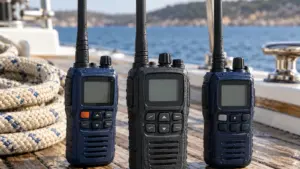
Choose a handheld VHF when you need to carry the radio around the boat, use it away from the helm, or keep communications available if the installed radio becomes inaccessible. In the handheld vs fixed mount vhf marine radio choice, portability is the main reason to add a handheld.
That makes a handheld useful when you’re moving around the boat rather than staying beside a fixed radio. It can also provide backup if a fire or another problem cuts off access to the installed radio or its power supply. BoatUS staged fire tests found that occupants might have only 3 to 4 minutes to make a mayday call and take other emergency actions before being forced overboard.
The tradeoff is that a handheld depends on its battery, and its built-in antenna is short. Battery runtime varies by model: the Standard Horizon HX320 is specified for 17 hours, while the Icom IC-M37 is specified for more than 12 hours.
Water protection and flotation also vary by model, so check the specifications before relying on a handheld around water. The HX320 is rated IPX7, floats, and is specified to withstand submersion to 1 m for 30 minutes.
Note
A waterproof handheld with DSC can be useful as backup, but portability alone doesn’t make every handheld waterproof or floating.
What does a fixed-mount VHF offer onboard?
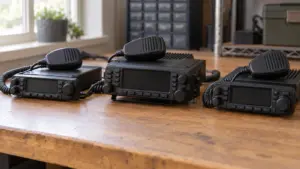
A fixed-mount VHF gives you an installed onboard radio connected to boat power and a separate marine antenna, making it a practical primary radio when your boat supports that setup.
Installation means connecting the radio to the boat’s electrical supply and running an antenna cable to a separately mounted VHF antenna; the radio needs that antenna connection to transmit and receive. The Garmin VHF 315, for example, requires a 12 V DC supply and a separate VHF antenna, while the Standard Horizon GX1410 manual gives model-specific instructions for connecting the antenna cable at the radio’s rear. Follow the instructions for your radio when choosing antenna position and cable, since requirements can vary by model.
Antenna height and placement affect line-of-sight range, so a fixed radio’s transmit power alone can’t tell you how far it will communicate. Performance also depends on the antenna, cable, connections, installation, and power supply; installing a fixed radio doesn’t guarantee a particular range. The Garmin VHF 315 supports transmit power from 1 W to 25 W, but that model’s power figures don’t establish the range you’ll get aboard your boat.
Once installed, a fixed-mount radio can serve as the boat’s primary VHF, while a handheld can provide communication away from the helm or if the installed set or its power supply becomes inaccessible. The fixed set is a sensible primary when your boat can support the power connection and separate antenna; keep a portable radio as backup if you need communication that doesn’t rely on the installed radio’s power or location.
Which radio should you choose for your boat?
Choose a fixed-mount VHF as your primary radio if your boat can support an installed radio, boat power, and a separately mounted marine antenna; add a handheld when you need communication away from the helm or backup capability. That’s the practical choice for most boats with a suitable installation, and the main decision in the handheld vs fixed mount vhf marine radio comparison.
It runs on its own battery, so it can remain available if the installed radio or its power supply becomes inaccessible, but it depends on battery power. Check the runtime for the specific model you’re considering; figures for individual handhelds don’t establish a runtime for every portable radio.
Before choosing, consider what your boat and typical use require:
- Installed setup: If the boat supports a 12 V installation and a separately mounted antenna, a fixed-mount radio is a practical primary.
- Portability: If you need to communicate away from the helm, a handheld can travel with you around the boat.
- Backup: If a fire or loss of access could take the installed radio out of reach, a handheld can provide a separate portable option.
- Antenna and installation: If your concern is communication range, consider antenna height, placement, cable, connections, and power supply, since transmit wattage alone doesn’t determine range.
Choose the handheld-first approach when portability or lack of installation support outweighs the benefit of a permanently installed primary, and consider a handheld backup when you want a radio that can remain accessible apart from the fixed setup.
Frequently Asked Questions
What should I check before relying on a handheld VHF’s battery?
Check the model’s stated operating time, battery condition, charge level, and charging arrangements before heading out. Keep the radio charged and accessible.
Do I need an MMSI number to use a marine VHF radio?
No, you can use a marine VHF for voice communication without entering an MMSI number. DSC distress alerts use an MMSI to identify the radio, and DSC messages can provide your coordinates to rescuers. If your radio has DSC, program its MMSI and keep the information accurate before relying on that distress feature.
Are VHF radios required on recreational boats?
Requirements depend on the boat and where you operate, so check the rules that apply to your vessel and location. Channel uses can differ by region and mode.
How high should I mount a VHF antenna?
Mount the antenna as high as practical, since antenna height affects line-of-sight range. Follow the radio manufacturer’s installation instructions for clearances and cable; for example, the Standard Horizon GX1410 manual specifies at least 3.28 feet (1 meter) between its antenna and the radio. That distance is model-specific, not a universal height rule.
Can a marine VHF radio communicate with a cell phone?
No, a marine VHF radio communicates over marine VHF channels, not directly with a cell phone. VHF coverage also depends on the antenna setup and other installation factors.
Conclusion
If your boat can support a powered installation and separate antenna, choose a fixed-mount VHF as your primary; add a handheld if you need communication away from the helm or a backup that isn’t tied to the installed set. If you can’t install a fixed radio, or need to carry your radio around the boat, choose a handheld and check its battery runtime and water protection before buying. Next, assess your boat’s power and antenna options, then match the radio to how you’ll use it.
Sources
- www8.garmin.com (www8.garmin.com)
- standardhorizon.com (standardhorizon.com)
- www8.garmin.com (www8.garmin.com)
- boatus.org (boatus.org)
- Boat Fire Safety Tests – BoatUS Foundation (boatus.org)
- icomamerica.com (icomamerica.com)
- boatus.org (boatus.org)
- navcen.uscg.gov (navcen.uscg.gov)
- standardhorizon.com (standardhorizon.com)
- standardhorizon.com (standardhorizon.com)