Difference Between Marine Radio and CB Radio
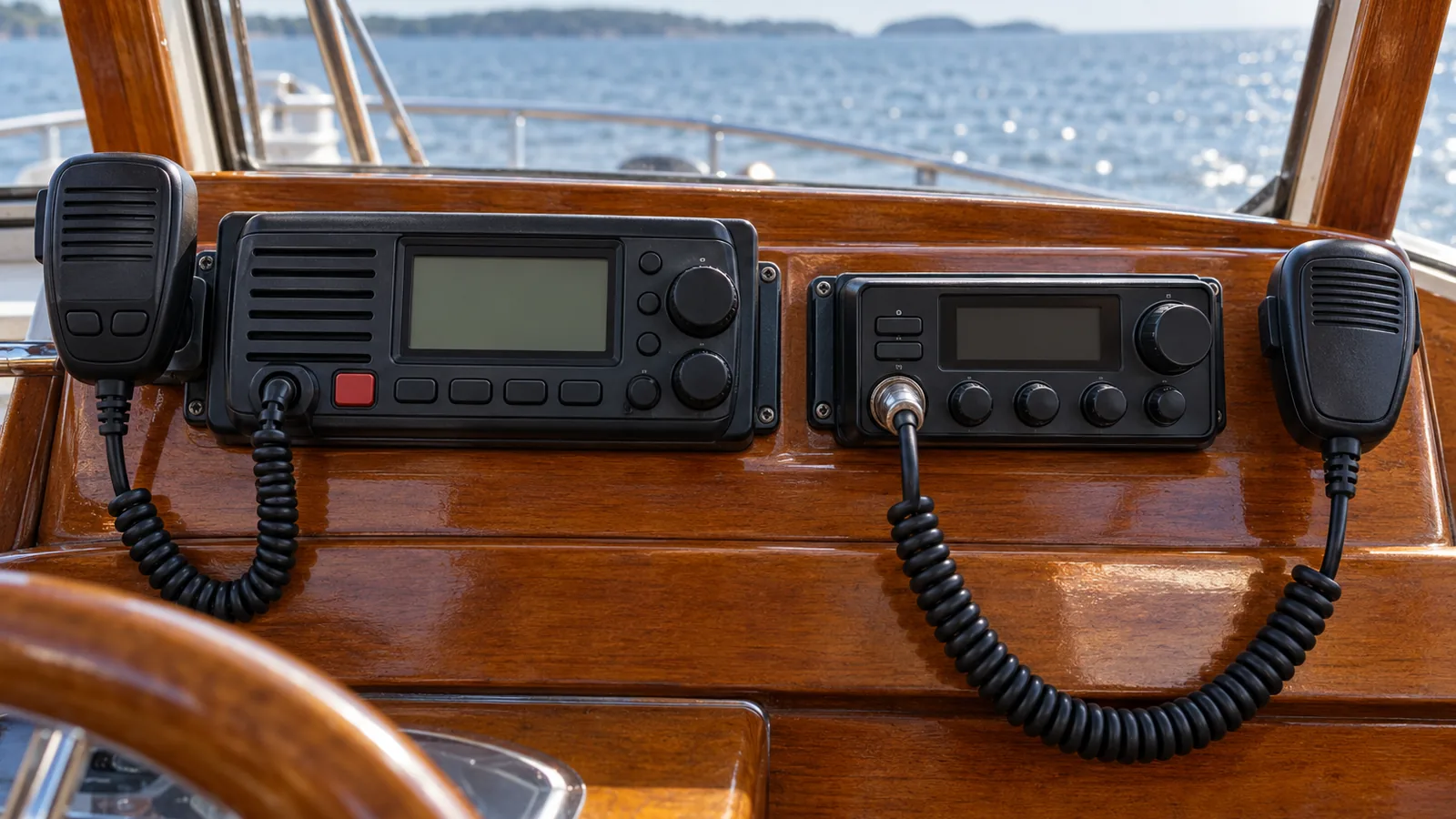
The difference between marine radio and CB radio is that they use separate frequency bands, so standard radios can’t communicate directly. For boating safety, use marine VHF: Channel 16 carries distress calls to the Coast Guard. CB can connect you with other CB users, but it can’t reach marine VHF users or the Coast Guard on Channel 16.
Choose CB for CB-to-CB communication and marine VHF for marine traffic and Coast Guard distress calls. Recreational boats aren’t generally required to carry marine VHF, but carrying a CB radio doesn’t meet marine VHF communication needs.
Key Takeaways
- Different frequency bands mean standard marine VHF and CB radios can’t communicate directly.
- Channel 16 uses different frequencies: marine VHF is 156.800 MHz; CB is 27.155 MHz.
- Use marine VHF Channel 16 for a voice distress call to the Coast Guard.
- A DSC alert uses Channel 70; follow it with a voice call on VHF Channel 16.
- Marine VHF range is generally 5–10 miles, with at least 20 miles to a Coast Guard station.
Marine Radio vs. CB Scorecard
Marine VHF and CB are separate radio services with different channel plans, so standard radios can’t communicate with each other. The CB limits below describe CB transmitters only; they aren’t a comparison with marine VHF output.
| Item | Value | Source |
|---|---|---|
| Shared CB frequencies | 40 | docs.fcc.gov |
| CB frequency range (MHz) | 26.965–27.405 | docs.fcc.gov |
| AM maximum mean carrier power (W) | 4 | docs.fcc.gov |
| SSB maximum peak envelope power (W) | 12 | docs.fcc.gov |
The key distinction is separate radio services: CB follows a defined U.S. channel plan, while marine VHF serves a different radio service. A matching channel number doesn’t establish compatibility, and the power limits shown here apply only to CB. For boating safety, choose marine VHF rather than treating CB as a substitute.
Round 1: Which Frequencies Can Communicate?
Ordinary marine VHF and CB radios can’t communicate directly because they use separate frequency bands. That’s the key difference between marine radio and CB radio for direct radio-to-radio communication.
| Radio or channel | Frequency (MHz) | Source |
|---|---|---|
| Marine VHF band | 156–162 | docs.fcc.gov navcen.uscg.gov |
| U.S. CB band | 26.965–27.405 | docs.fcc.gov navcen.uscg.gov |
| Marine Channel 16 | 156.800 | docs.fcc.gov navcen.uscg.gov |
| CB Channel 16 | 27.155 | docs.fcc.gov navcen.uscg.gov |
The bands don’t overlap, so a standard radio in one service can’t reach a standard radio in the other. The same channel number doesn’t mean the same frequency: marine Channel 16 and CB Channel 16 use different frequencies. Choose a radio that matches the service used by the people or agencies you need to contact.
Round 2: Which Radio Handles Distress Calls?
Marine VHF is the clear choice for a boating emergency because the Coast Guard’s voice-distress procedure uses VHF Channel 16. A CB radio can’t carry out that call to the Coast Guard.
- Use VHF Channel 16 for a voice distress call, the channel specified for this procedure.
- Say “MAYDAY” 3 times, then give your vessel’s name, position, the nature of the distress, and the assistance needed.
- If your marine radio has Digital Selective Calling (DSC), send a distress alert on Channel 70.
- After sending the DSC alert, contact the Coast Guard on VHF Channel 16 and communicate the distress information.
- Position depends on GPS: A DSC alert includes your position only if the radio has an internal GPS receiver or is connected to a GPS.
Round 3: Can You Use CB Aboard?
You can use a CB radio aboard a boat to communicate with other CB radios, but it can’t reach marine VHF users or the Coast Guard on Channel 16. A CB set can support communication with others using CB, but it isn’t a substitute for a marine safety radio.
For boating emergencies, marine VHF is the relevant radio because Coast Guard distress and watch procedures use marine VHF channels, not CB.
Recreational boats are not generally required to carry marine VHF. That doesn’t make CB an equivalent safety option: the Coast Guard’s distress and watch procedures still use marine VHF channels. Choose the radio based on whom you need to contact. CB can serve for CB-to-CB communication aboard, while marine VHF is the appropriate choice for Coast Guard-related distress and watch communications.
Check the requirements for your boat, and don’t rely on CB to meet marine VHF communication needs.
Round 4: What Affects Range and Monitoring?
Marine VHF is mainly a short-range radio. The U.S. Coast Guard gives a general range of 5–10 miles, with at least 20 miles to a Coast Guard station. These figures describe marine VHF, not a direct comparison with CB; no comparable CB range figure is provided here.
Range figures are practical guidance, not a promise of contact at a fixed distance. Keep a watch on marine Channel 16 while you’re not communicating, or on Channel 9 where applicable. A watch means monitoring the channel for calls, including distress traffic, rather than leaving the radio tuned elsewhere.
CB antenna installation has specific height limits: 60 ft above ground or up to 20 ft above the highest point of the structure supporting it. Those are alternative limits, not two heights you add together. Check which limit applies to your installation before mounting the antenna. The supplied CB information gives no matching range estimate, so don’t use antenna height alone to infer how far a CB transmission will reach.
For a boat carrying marine VHF, keep the radio set to the applicable watch channel when you’re not transmitting.
Frequently Asked Questions
Do I need a license to use a marine radio or CB radio in the United States?
For ordinary recreational use in the United States, you generally don’t need a license for CB, and recreational boats aren’t generally required to carry marine VHF. Marine VHF is still the appropriate radio for Coast Guard distress and watch communications, which use marine channels rather than CB.
Can I use a marine VHF radio to talk to people on land?
Yes, if the land station is also using a compatible marine VHF channel and the communication is permitted for that channel’s purpose.
What antenna does each radio need?
A CB radio needs an antenna suited to the CB band, while a marine VHF radio needs one suited to marine VHF; the bands are separate, so the radios can’t communicate directly. For CB, U.S. rules limit antenna height to 60 ft above ground or up to 20 ft above the supporting structure’s highest point.
Are there radios that work on both CB and marine bands?
A standard CB radio and a standard marine VHF radio can’t communicate directly because their frequency bands don’t overlap. A dual-band device would need to support both services, and you must use marine VHF for Coast Guard distress communication on Channel 16.
Can I use a handheld marine VHF radio without a license?
Recreational boats are not generally required to carry a marine VHF radio. Keep in mind that marine VHF channels have assigned purposes, and improper channel use may be subject to FCC fines.
Conclusion
If you need to contact other CB users aboard, choose CB; if you need a radio for marine traffic or Coast Guard distress communication, choose marine VHF. Don’t buy CB as a stand-in for marine VHF, since the two services can’t communicate directly.
Before buying, check the requirements that apply to your boat, then choose a marine VHF radio if you need marine communication. Learn how to make a distress call and keep the radio on the applicable watch channel when you’re not transmitting.
Sources
- docs.fcc.gov (docs.fcc.gov)
- U.S. VHF Channel Information | Navigation Center (navcen.uscg.gov)
- GMDSS Frequently Asked Questions | Navigation Center (navcen.uscg.gov)
- uscg.mil (uscg.mil)
- DSC Distress | Navigation Center (navcen.uscg.gov)
- docs.fcc.gov (docs.fcc.gov)
- homedepot.com (homedepot.com)