CB Radio vs Walkie Talkie: Which Should You Choose?
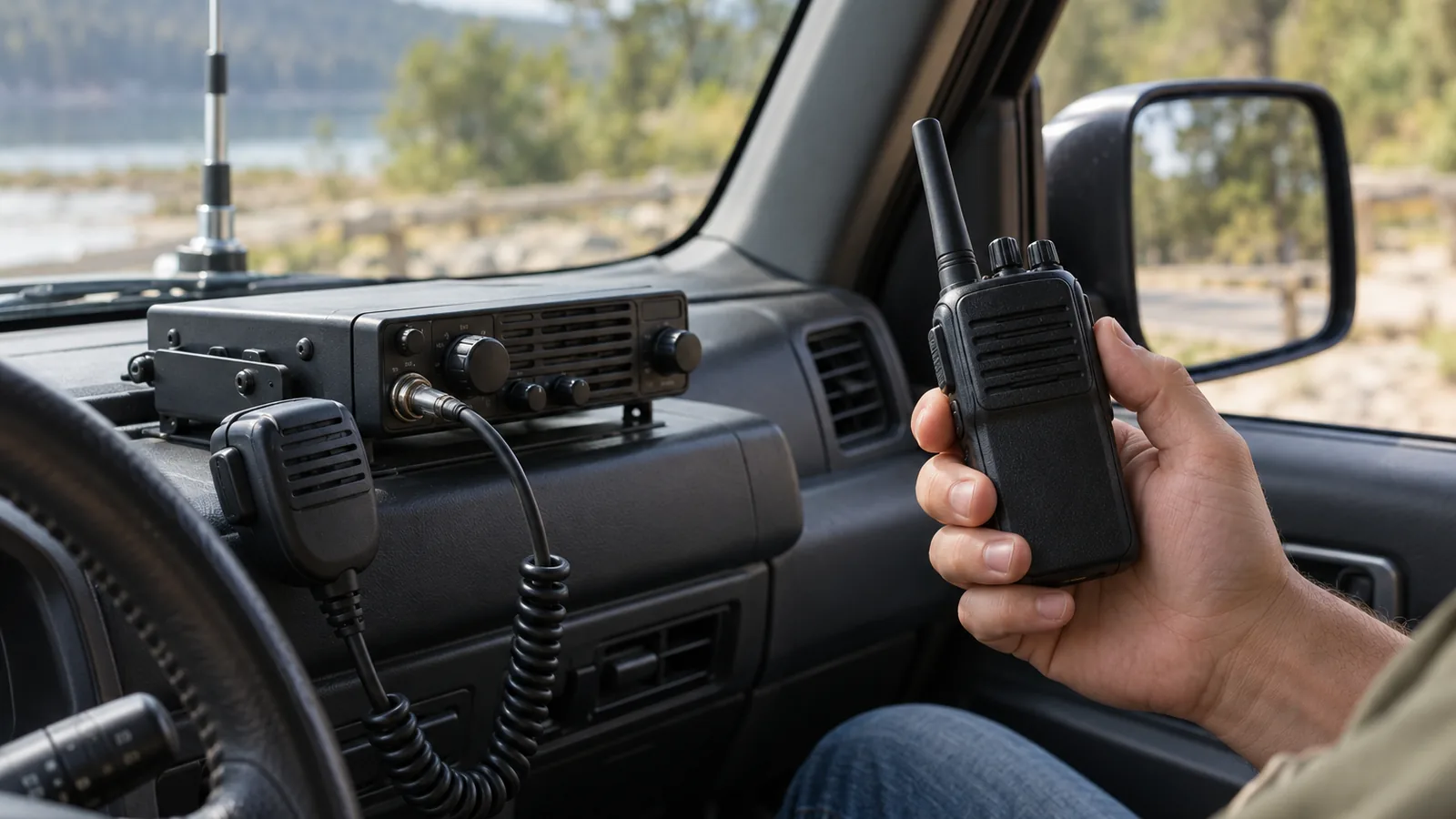
For cb radio vs walkie talkie, choose a mobile CB with an external antenna for vehicle-to-vehicle contact, with an estimated 5–7-mile range in optimum conditions. Choose an FRS or GMRS handheld when you’re on foot because it’s easier to carry; FRS typically covers about 0.5–2 miles. A handheld CB can work for short-range tasks, but it can’t communicate directly with FRS or GMRS radios.
Terrain, obstructions, and antenna setup can all cut real-world range. Midland’s 28-mile figure for the T51 applies only in ideal conditions.
Key Takeaways
Mobile CB with an external antenna suits vehicle-to-vehicle contact; FRS or GMRS handhelds are easier to carry on foot.
FRS needs no license and typically covers about 0.5–2 miles, depending on conditions.
GMRS requires an FCC license; its handheld radios can communicate with FRS radios on shared preprogrammed channels.
FRS two-packs start at $39.99, compared with $79.99–$209.99 for a mobile CB, before the separate antenna cost.
Quick Verdict: Vehicle or Foot?
A mobile CB with an external vehicle antenna is the better fit for highway travel and contact between vehicles; an FRS or GMRS handheld is easier to carry when you’re on foot. The right choice depends on where you’ll use the radio and who you need to reach.
Choose a mobile CB if you want to communicate from a vehicle, such as coordinating with other drivers or keeping in touch during a trip Cobra. Its external antenna suits vehicle-to-vehicle use, while a handheld CB’s short stock antenna can limit its usefulness inside a car.
Choose an FRS or GMRS handheld for walking, camping, or coordinating a nearby group. Handhelds are portable, and FRS radios typically cover about 0.5–2 miles, though actual range depends on conditions. A handheld CB can work for short-range tasks such as walking around a vehicle or coordinating at a campsite.
Here, “walkie-talkie” means an FRS or GMRS handheld, not one specific radio service. FRS and GMRS share preprogrammed channels, so radios from both services can communicate on those channels. CB uses a different service, so it won’t communicate directly with FRS or GMRS radios.
For a simple decision: pick a mobile CB for vehicle-to-vehicle contact, or an FRS handheld for straightforward local coordination without a license. Choose GMRS if its handheld options suit your needs and you’re willing to get the required license. A handheld’s convenience doesn’t make its range equivalent to a vehicle radio with an external antenna; antenna setup and conditions affect what you can reach.
CB Radio vs Walkie-Talkie Specs and Costs
Mobile CB and FRS/GMRS handhelds serve different setups: CB fits vehicle use, while handhelds are easier to carry on foot. Prices range from $39.99 for an FRS two-pack to $209.99 for a mobile CB, before adding a vehicle antenna.
| Radio service and band | Power | Licensing | Portability and setup | Listed price |
|---|---|---|---|---|
| FRS, UHF FM, 462–467 MHz | 2 W or less | No license | Handheld; fixed antenna | T10 two-pack: $39.99; T51: $59.99; T71 two-pack: $99.99 |
| GMRS handheld | Up to 5 W | FCC license required | Handheld; compatible with FRS on shared preprogrammed channels | GXT1000: $49.99; two-packs: about $109.99–$169.99 |
FRS and GMRS handhelds use UHF; traditional CB uses AM, so the services differ in operating setup. Midland advertises the T51 at up to 28 miles, but that figure assumes ideal conditions; its typical FRS estimate is about 0.5–2 miles. Treat advertised maximums as conditional, not as a reliable expectation for everyday use. The listed prices make an FRS two-pack a lower-cost starting point, while a mobile CB setup adds the cost of a separate antenna kit.
How Range Depends on Radio and Antenna
A mobile CB has the strongest range estimate here, but only under optimum conditions; handheld results vary sharply with antenna and surroundings. Terrain and antenna setup can cut range well below advertised or optimum-condition figures.
| Radio or setup | Range (miles) | Conditions | Source |
|---|---|---|---|
| Mobile CB | 5–7 | Optimum conditions | cobra.com |
| Handheld CB | About 2 | Optimum conditions | cobra.com |
| Handheld CB, short stock antenna | 0.75–1 | Flat, open conditions | support.cobra.com |
| FRS handheld | 0.5–2 | Typical range | support.midlandusa.com |
| Midland T51 FRS | Up to 28 | Advertised maximum, ideal conditions | midlandusa.com |
The T51 figure is a best-case maximum. It assumes no obstructions, charged radios on high power, and a flat surface or unobstructed line of sight. Terrain, buildings, trees, interference, weather, and obstructions can all reduce actual range.
For CB, antenna height, length, placement, and a proper installation affect performance; a higher, longer antenna generally performs better. Check SWR, the measure of how well the antenna system is matched to the radio, and keep it below 3; higher readings can shorten range and may overheat or damage the transmitter. A short stock antenna inside a car is especially limiting, so use an externally mounted mobile antenna for vehicle communication.
Licensing, Compatibility, and Radio Setup
If you want simple, license-free use, choose CB or FRS. CB and FRS need no license. GMRS requires an FCC license; Midland lists a $35 fee, a term of up to 10 years, and coverage for the licensee and family. That makes the choice in a cb radio vs walkie talkie comparison partly about who will use the radios and whether you want to handle licensing.
For family or group use on foot, FRS and GMRS handhelds can communicate on their shared preprogrammed channels. CB radios use a different band from FRS and GMRS, so a CB cannot communicate directly with those handhelds.
Midland classifies radios operating at 2 watts or less as FRS, while radios above 2 watts and up to 50 watts are GMRS; GMRS handhelds are allowed up to 5 watts. On GMRS, channels 1–7 are limited to 5 watts, channels 8–14 to 0.5 watts, and channels 15–22 to a maximum of 50 watts.
For vehicle-to-vehicle use, a mobile CB needs an external antenna mounted on the vehicle. Antenna setup matters: antenna height, length, and proper SWR matching affect CB range. You can also use a mobile CB as a home base station with a 12–14 V DC supply rated at 3 A or higher and a base-station antenna; Cobra advises against using a car mobile antenna for this setup. If you want to run a CB at home, plan for both the power supply and a suitable antenna.
Who Can You Reach, and Are Conversations Private?
CB Channels: Nearby Users, Not Just Your Group
A CB radio can reach anyone nearby who’s monitoring the same channel, so your audience may extend beyond your passengers or travel group. 40 CB channels give users multiple places to communicate, and channel 19 is commonly used for general contacts and traffic reports. That can help when you want to hear from other CB users nearby, though you can’t count on a particular person monitoring your channel.
Handheld Channels: Coordinate on Compatible Radios
FRS and GMRS handhelds work well for coordinating with people who have compatible radios and are set to the same channel. FRS and GMRS radios share preprogrammed channels, so the two services can communicate on those channels. FRS radios operate in FM between 462 and 467 MHz, while traditional CB uses AM. Before you head out, agree on the channel and any settings your radios use.
Why Neither Radio Type Is Secure
Treat ordinary CB and consumer walkie-talkie transmissions as public: people with compatible radios who are monitoring the same channel may hear you. A privacy code doesn’t make your speech private or prevent someone else from listening to the channel; it’s a compatibility setting, not a guarantee of confidentiality. The shared FRS/GMRS channels make that limitation clear, since radios from either service can communicate on them. Keep sensitive details off the air, and use a private communication method for information you don’t want others to hear.
Frequently Asked Questions
What are the GMRS channel power limits?
GMRS channels 1–7 allow up to 5 W, channels 8–14 allow up to 0.5 W, and channels 15–22 allow up to 50 W. Channel limits vary by group; handheld GMRS radios are limited to 5 W, so the 50 W limit applies to radios capable of that output, not handhelds.
Can I use a car CB antenna for a home base station?
You can use a mobile CB radio at home, but pair it with a base-station antenna rather than a car antenna. Use a 12–14 V DC supply rated at 3 A or more, and follow Cobra’s advice against using a mobile car antenna for a home base setup.
Why should a CB antenna be tuned on the vehicle?
Tune the antenna on the vehicle because the vehicle’s metal commonly acts as the antenna’s ground plane, which affects how the system is matched. A poor match can compromise performance, so tune the installed antenna in its actual operating position.
Should a group use CB, GMRS, or both?
Use GMRS handhelds for a group moving on foot, or mobile CB radios when the group needs vehicle-to-vehicle contact. CB and GMRS can’t communicate directly; if your group uses both, assign compatible radios within each part of the group rather than expecting the services to connect.
Can GMRS handheld radios use repeaters to extend their range?
Yes, GMRS can use repeaters to extend communication range, but the broad GMRS range estimate isn’t specific to handheld radios. FRS radios aren’t repeater-capable, so choose GMRS handhelds if repeater access is part of your plan, and check that the radios support repeater use.
Conclusion
If you’ll mainly communicate between vehicles, choose a mobile CB and plan for an external antenna; if you’ll coordinate with people on foot, pick FRS for simple license-free use or GMRS if you’re prepared to get its license. Before buying, decide who needs to communicate and where you’ll use the radios, then confirm everyone can use a compatible service and channel. For a CB vehicle setup, include antenna mounting and installation in your plan, since the radio alone won’t provide the intended vehicle-to-vehicle setup.
Sources
- Cobra FAQs | Frequently Asked Questions & Answers (cobra.com)
- FRS and GRMS 101 (support.midlandusa.com)
- support.cobra.com (support.cobra.com)
- midlandusa.com (midlandusa.com)
- uniden.com (uniden.com)
- cobra.com (cobra.com)
- tractorsupply.com (tractorsupply.com)
- midlandusa.com (midlandusa.com)
- firestik.com (firestik.com)